I managed to pull off a decent finish of 5:45 at the Night Hawk 50k. Not bad for an old guy.
Night Hawk 50k
Pages
Hawk 100 Race Report
Everything went well. I had little or no trouble until the last 3-5 miles. My right shin (anterior tibialis) was very sore. I was able to run-walk up until this point. I think the last 3 miles in from Lake Henry took about 2 hours. I should have finished at 26 hours but managed to eeek out a run across the line at 27:29. I am very pleased with my time. Next up, the Zion 100 in April with any luck.
Flickr Collection
Flickr Collection
Pre-Race Checklist
I'm running my first 100 miler this weekend (http://hawkhundred.com) so I have been doing a lot of reading. Here's a great list of checklists.
http://www.ultrunr.com/checklist.html
Home
Experience From - Andy Holak , Tracey Grzegorczyk , Ray Zirblis , Dave Olney ,
Andy Holak
I'm wondering if any of you have an organized checklist of what you take for a 100 mile trail run. I have a feeling that many of you do. I've always been a pretty laid back runner, not stressing out a lot about what I have or my equipment, just running. As someone said recently, running really is a pretty simple thing. But....after three years of ultrarunning, running races of 50 miles or less, I'm attempting my first 100 miler! So, I'm actually getting a little excited/nervous/stressed(just a little). I don't want to forget anything. Any help would be appreciated. Thanks!
Tracey Grzegorczyk
I thought it might be helpful to post an old list I have of things I've used in Ultimate Ultra Crew Kits. Whether left as a drop bag, or carried by one of your crew, this kit can get you through most tight spots and back to running. While all this stuff can be thrown into a shoebox or grocery bag, the ideal way to pack it is in a fishing-tackle box. Yes, I'm serious... all those little trays makes it much easier to find what you're looking for without wasting time.
From memory, so I'm sure I'm leaving out something important, the list included:
Ray Zirblis
This is going to come across as much more organized than I actually am, but maybe it will help you out. I break my stuff down into mental catagories that become piles on my bedroom floor, and then get put into stuff sacks for the car, as follows:
If I am flying, I do the same catagories with a 3rd of the items, so that I can bring my luggage carry-on. My dream is to be like my pal, Newton Baker, who goes to a hundred miler with a small bag that wouldn't hold me on an afternoon trip to the gym, but I'm not there yet. To me, packing light is an exercise like being concise in writing. It takes me lots of time, and I rarely do it for runs.
Dave Olney
Being an obsessive planner, I have an ultra checklist that I've been refining for the past 15+ years. Of course, you have to customize it to your own preferences and the kind of "stuff" you use, but here's my list:
1. Items
http://www.ultrunr.com/checklist.html
100 Miler Check List
HomeExperience From - Andy Holak , Tracey Grzegorczyk , Ray Zirblis , Dave Olney ,
Andy Holak
I'm wondering if any of you have an organized checklist of what you take for a 100 mile trail run. I have a feeling that many of you do. I've always been a pretty laid back runner, not stressing out a lot about what I have or my equipment, just running. As someone said recently, running really is a pretty simple thing. But....after three years of ultrarunning, running races of 50 miles or less, I'm attempting my first 100 miler! So, I'm actually getting a little excited/nervous/stressed(just a little). I don't want to forget anything. Any help would be appreciated. Thanks!
Tracey Grzegorczyk
I thought it might be helpful to post an old list I have of things I've used in Ultimate Ultra Crew Kits. Whether left as a drop bag, or carried by one of your crew, this kit can get you through most tight spots and back to running. While all this stuff can be thrown into a shoebox or grocery bag, the ideal way to pack it is in a fishing-tackle box. Yes, I'm serious... all those little trays makes it much easier to find what you're looking for without wasting time.
From memory, so I'm sure I'm leaving out something important, the list included:
- ibuprofin, asprin and tylenol
- tums rolaids and/or pepto-bismol
- rocksalt and potassium tablets, electrolyte tablets, and/or quinine capsules (if you can find them);
- alcohol wipes and antibiotic ointment
- compeed or nu-skin
- moleskin
- ace bandage
- band-aids
- sports tape & foam pre-wrap
- scissors
- safety pins (& swiss army knife)
- bandanas or cotton rags
- baby wipes
- tissues
- vaseline, runner's lube or bag balm
- sunscreen and lip balm
- matches
- gu or other gel packets.
- extra socks
- extra flashlight batteries and bulbs
- beesting kit and sudafed
- tecnu
- cool n' fit spray
- extra water and ice, etc. depending on the terrain and distance.
Ray Zirblis
This is going to come across as much more organized than I actually am, but maybe it will help you out. I break my stuff down into mental catagories that become piles on my bedroom floor, and then get put into stuff sacks for the car, as follows:
- What I need before the race (directions, alarm clock, breakfast, pins to attach my race number, etc.),
- What I will be wearing to start with
- What I'll be carrying to start with (maybe a belt, water bottle, belt pouch with electrolyte caps, tape, compeed, meds, car key, a little emergency food, etc.)
- What I'll need if it rains ( laundry bag, rain coat, extra shoes, socks)
- What I'll need for night time (small lights, batteries)
- Stuff I'll want after the run such as a change of clothing, shower stuff, comfortable shoes. I also bring a bag or box of medical and repair items (like various tapes, Tiger Balm, NSAIDS, shears, foot powder, vasoline, and the like) for taping up before the run and getting me home after it.
If I am flying, I do the same catagories with a 3rd of the items, so that I can bring my luggage carry-on. My dream is to be like my pal, Newton Baker, who goes to a hundred miler with a small bag that wouldn't hold me on an afternoon trip to the gym, but I'm not there yet. To me, packing light is an exercise like being concise in writing. It takes me lots of time, and I rarely do it for runs.
Dave Olney
Being an obsessive planner, I have an ultra checklist that I've been refining for the past 15+ years. Of course, you have to customize it to your own preferences and the kind of "stuff" you use, but here's my list:
1. Items
- airline tickets/itinerary
- alarm clock
- alcohol wipes
- bandannas
- batteries & bulbs
- blanket & tarp
- bluejeans & belts
- bottled water
- bottles, fanny pack
- bottles, hand-strap
- camera & film
- cap (knit)
- cap (running)
- cap (street)
- dop kit
- drink powder
- drop bags
- energy bars
- fanny pack
- first aid kit
- flashlights
- fleece
- folding chair
- food & drinks
- gaiters
- gel bottle
- gel flasks
- gel holster(s)
- gloves
- headlamp
- hydrocortisone
- ice chest
- jackets
- knife/scissors
- maps
- money & wallet
- motel info
- muscle relaxant
- pace/split times
- pajamas
- powder bottles
- race info & maps
- rain shell
- reading glasses
- reading materials
- rubber gloves
- safety pins
- shirts, long-sleeve
- shirts, polypro
- shirts, short-sleeve
- shoes & backups
- shorts (running)
- shorts (street)
- singlets
- slippers
- soap & towels
- socks (running)
- socks (street)
- space blanket
- stopwatch
- stove & fuel
- sun glasses
- sun screen
- sweatshirts
- sweatsuits
- tape (duct, medical)
- Tevas
- tights
- toilet paper
- underwear (running)
- underwear (street)
- vaseline
- walkman & tapes
- wet bags
- zantac, alieve, salt
- buy food & ice
- carbo load & hydrate
- check for burrs in socks
- fill & label drop bags
- fill fanny pack
- get gas & oil
- phone pacer(s)
- pin hanky on hat
- remove jewelry
- band-aid nipples
- go to briefing & weigh-in
- carbo load & hydrate
- deposit drop bags
- gas up the car
- pin on race #
- plan with crew & pacer
- set alarm clock
- mix drink powder & fill water bottles
- apply sunscreen, hydrocortisone, vaseline
- check flashlight for start line
- check stopwatch
- eat & drink something
- go to the toilet
- check-in at start line
- race # pinned on?
- Got ice & bottled water for me?
- Got food & drinks for crew?
- Got gas?
- Got alarm clock?
- Get me in & out of aid stations quickly (ideally <5 minutes, max 10 minutes).
- When you arrive at each aid station, check crew notes for things I will need there.
- Arrange gear in car or on a mat so you can find things quickly.
- Pre-mix and chill drinks if possible
- Have 2 bottles + hand-strap bottle ready
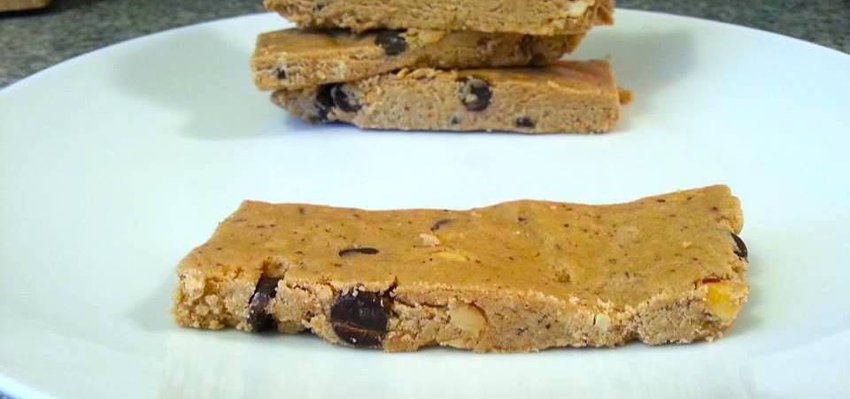
Peanut Butter Protein Bars
Chocolate Peanut Butter No-Bake Protein Bars (Vegan + Gluten-Free)
Ingredients
- 3 cups gluten-free rolled oats, blended into a flour
- 1 cup protein powder (I used a mild vanilla pea protein)
- 1/4 tsp sea salt
- 1/4 tsp cinnamon
- 1 cup peanut butter (or use any nut butter of your choice)
- 1 cup maple syrup (or use honey if you’d like)
- 1/3 cup dairy-free chocolate chips or raw cacao nibs
Directions
- Stir together oat flour, protein powder, sea salt and cinnamon.
- Add in peanut butter and maple syrup, stirring well to combine. Mixture will be rather thick and dry. Add in a splash of almond milk if necessary.
- Stir in chocolate chips or raw cacao nibs, distributing evenly.
- Press the mixture into a wax paper-lined 9x13 pan, using a rolling pin on top to smooth if necessary.
- Place in freezer for about 10 minutes for bars to harden up. Remove and cut into 20 bars.
- To store: Wrap each bar individually in plastic wrap and store in the freezer in a container or air-tight bag.
New City Bike Map
We all know that runners and riders are close friends when it comes to the trails we use every day. When we can't enjoy the trails in the woods, we have to resort to trails or paths in town. I am very fortunate to live in a community that is bicycle friendly. That means more available trails or paths for runners as well. The City of Lawrence has just published a new map with the designated trails around town and it's a beauty.

Western States Lovin'
Here are some good links for Western States information. it would be a dream for me to run that race some day.
Gordy Ainsleigh Interview
Gordy Ainsleigh Video from Outside Magazine
Unbreakable Movie Link
Gordy Ainsleigh Interview
Gordy Ainsleigh Video from Outside Magazine
Unbreakable Movie Link
Everyone jump on the protein bandwagon, quick! I keep trying to find healthy ways to increase my protein intake. Here's a good source.
http://blog.fooducate.com/2014/06/09/the-right-way-to-think-about-protein/
- 4 oz chicken breast – 25 grams
- 4 oz hamburger – 20 grams
- Glass of milk – 8 grams
- Low fat yogurt 10 – 12 grams
- Greek yogurt – 14-18 grams
- 1 medium egg – 6 grams
- 2 slices of whole grain bread – 6-10 grams
- 2 tbsp of peanut butter – 8 grams
- Handful of almonds – 7 grams
- Mozzarella cheese string – 6 grams
Three Step Rx for Contentment
http://www.mindbodygreen.com/0-3973/Three-Step-Rx-for-Contentment.html
As prescribed by my doctor just a few months ago...Thank you, Dr. Park.
1. Accept reality. Lower expectations.
Expectations can be some of the most powerful saboteurs of santosha. Expecting how a future experience will unfold is a recipe for disappointment: think Senior Prom or New Year’s Eve. Often our expectations of how an event will be and the reality of what is are on opposite sides of the spectrum. By setting expectations aside, we can actually be in the moment that is, not in some illusory notion of what should be. It’s a very cool and challenging practice and you just might notice yourself paying closer attention and seeing things you wouldn’t have noticed had you been looking for a fulfilled expectation.
2. Think the good thought.
Obviously we do not have control over everything, in fact, we have very little control over what happens around us. It has become a bit of a cliché, but I have to say it anyway, no matter how out of control of a situation we may be, we do have control of our thoughts. You control your thoughts. Your thoughts do not control you. Notice where your mind goes. How often do you actually stop to acknowledge what you are thinking about? Pay attention to what you think about and if you are just thinking about something because you are in the habit of thinking about it. If your thoughts aren’t nourishing you and nurturing you, change your mind. Think the good thought.
3. Be in the present moment.
When I am in the present moment, I am undoubtedly OK. Inevitably this moment will move into the next. No matter what this moment holds, it will change, it will ebb and it will flow. Everything is manageable in this present moment. It is all there really is, after all.
How to be Tough as Nails Mentally for Your 100 Miler
1. Just make it to the Next Aid Station: Forget about thinking of a 100 miler in terms of 100 miles. Instead think only about getting to the next aid station. Chances are that as bad as you feel at any given moment you will admit that you can make it to the next aid station. This rule is all about staying present where you are and not letting your fears take over. It's very hard for the mind to grasp 100 miles, or even having another 30 miles to go when you've just done 70 miles, but it's as simple as putting one foot in front of the other.
2. Remember it's #2 Kind of Fun: In other words, it's the kind of fun that you will look back on and say, "Gee that was so much fun! I'm so glad I finished that race!" Despite being miserable as hell for 80 miles. As odd as this sounds, it's true that you will most likely look back on your experience with a certain fondness and a new appreciation for what your body is capable of. This rule is courtesy Richard K. who kindly explained to me the difference between Fun #1 and Fun #2 (Fun #1 is fun at the time of the event like having a beer with your buddies, in case you were wondering).
3. Have a Bad Memory: Or rather a selective memory. It's important not to stress out about your perceived shortcomings, especially ones that are based on past experiences. Be gentle with yourself about past DNF's and poor performances. In fact, just forget about them as negative events and instead mine them for the gems that they are. My first 100 miler was a pretty big disaster at least according to my goals at the time but I learned that I needed to train with gear I'd use in the race and to fuel more mindfully to avoid the dreaded 100 mile nausea.
4. Less is More: Set yourself up to succeed mentally in your 100 miler by not overtraining and by tapering properly. If you feel good for longer physically during the race, you'll be ahead of the game. In training it means that it's better to do less mileage than too much. For example, if you overload your body with 10-20 more miles a week than your body can adapt to, you are back tracking your training. If you'd done exactly the milage your body can handle you would hit that sweet spot where you are getting maximum benefits for maximum mileage. Here's the trouble with trying too hard to hit that perfect spot: we don't have any way of knowing exactly where that sweet spot is each week or day other than listening to our body and our intuition. That is why it's better to err on the side of fewer miles than too many. Cross training can help close that gap between doing too few miles and your sweet spot-- without stressing your body out in the same way that only running mileage does. That being said, you can also under train which can be disastrous in a 100 mile race. You want to be prepared and have your body ready to handle the stress of the race.
5. Exercise Your Mental Muscles: I'd right out say just do yoga everyday, but I admit there are other mental-physical practices that will get you similar results. For me, yoga is perfect for honing my mental muscles as it combines physically difficult poses with flowing breath which activates deep calmness during extreme physical strain. I enjoy hot vinyasa power yoga as the heat adds another element of stress to the body, further challenging my mental fortitude. This heat is great for runners who find regular yoga to not be challenging enough or who need heat training for an ultra.
6. Strategic Visualization: We visualize things all the time. How often do we visualize exactly what we want? Leading up to your race take a little time each day, preferably after a meditation or yoga practice when you are relaxed, to visualize your race going exactly as you want it to. Be very detailed in your vision. During your race return to the vision when you find yourself moving into fear or visualizing negative events. I can't stress enough that this is the most important key to 100 mile mental success. If you only do one of these mental strengtheners, do this one. Well, on second thought do the breathing one too.
7. Breathe: This one is deceptively simple and it's often overlooked. Feeling overwhelmed during a race? Breathe. Getting overly negative? Breathe. Climbing 5,000 feet in 5 miles? Breathe. Breath calms the body and connects us with the present. Being present is the key to mental strength. I highly recommend a regular breathing practice like yoga as it trains you how to use the breath through movement, something you can't learn during a 100 miler, you must practice beforehand.
8. Eat and Hydrate Regularly: The brain and your mental will power will fail if you do not hydrate and fuel properly. It's not as simple as it sounds of course: 100 mile nutrition is an art and it varies for each individual. That being said, you'd be best off trying to figure out what works for you as a well fed body will deliver incredible results.
9. Make Friends: Put away your Ipod and start talking to the runners around you. There's strength in numbers and strength in sharing our joys, pain and suffering. Not only will the miles fly by but you'll make new friends. At Zion 100 this past weekend, I made more friends than I've ever made in a race and not so coincidentally, I had more fun than I've ever had in a 100 miler. Three of us got about an hour and a 1500 foot extra climb off course and instead of suffering by ourselves we made a pact to run the rest of the race together and through that friendship we were stronger than any one of us was alone. It was a powerful lesson in the magic of friendship and camaraderie. I also make an effort to say something encouraging to every runner I cross paths with, it reminds me to smile and I hope it gives them a little boost.
10. Smile: Even if you have to peel your lips up your face, do it. Smiling works: it activates the brain to begin to think more positively and amazingly it helps you actually feel like smiling. Plus, you'll surely entertain the runners around you with your clown grin.
Subscribe to:
Posts (Atom)